Precise measurement of gaskets is vital to guarantee effective sealing. Whether dealing with circular flanges or rectangular frames, mastering the correct measurement methods ensures you specify the exact gasket required. This detailed guide outlines essential techniques for measuring the most common gasket types.
Measuring Flange Gaskets
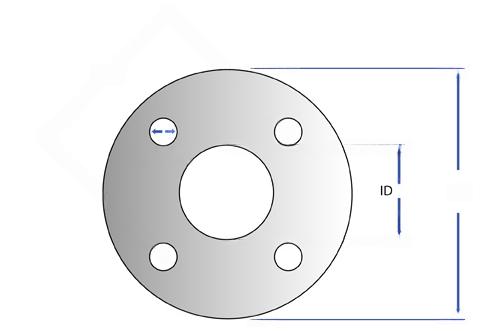
Method 1: Pitch Circle Diameter (PCD)
Full-face gaskets include bolt holes arranged around the gasket surface. To measure these accurately, determine the Pitch Circle Diameter, which is the diameter of an imaginary circle passing through the centres of all bolt holes. A practical approach is to measure from the inner edge of one bolt hole directly across to the outer edge of the opposite hole, assuming uniform hole sizes. Don’t forget to note the material thickness, as this is essential for complete gasket specifications.
Method 2: Inner Bolt Circle (IBC) Gaskets
Ring-style gaskets without bolt holes on the face require a straightforward measurement method. These are defined by two main dimensions: the outer diameter (OD) and inner diameter (ID). Use a tape measure to record the widest points across both the outer and inner edges, measuring edge-to-edge. Including the material thickness with these diameters provides all necessary details for accurate quoting and production.
Flange Gasket Tables - Access our full range of standard flange gasket tables via this link.
Measuring Picture Frame Gaskets
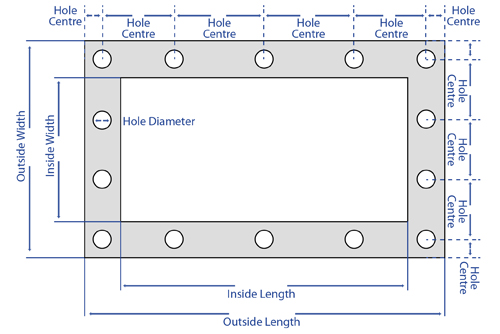
For rectangular and square gaskets, it’s important to measure both external and internal dimensions carefully. Use a tape measure to determine the overall length and width, then measure the internal aperture similarly. Most picture frame gaskets feature bolt holes evenly spaced around the edge—while these are usually consistent in size and spacing, it’s advisable to verify rather than assume. The diagram above highlights the critical measurements needed to specify a picture frame gasket accurately.
If you find measuring complex gaskets challenging, our technical experts are here to assist. We offer several support options including detailed phone guidance to help you measure correctly, site visits where our engineers can take measurements for you, or the option to send us a sample gasket for replication. Please contact our sales team to discuss the best solution for your needs.
Additional Considerations When Measuring Gaskets
To provide an accurate quotation, please supply the following key information:
Order Quantity
Application:
- Identify the system or equipment the gasket will seal.
Size Details:
- Reference to any standard flange type, if applicable.
- All measurements as illustrated in the diagrams above, including number of holes and material thickness.
- Technical drawings for any non-standard gasket designs.
Material Selection Criteria:
-
Type of media being sealed (gas, liquid, powder).
-
Operating temperature range (minimum and maximum).
-
Chemical compatibility requirements (acids, alkalis, solvents, hydrocarbons, etc.).
- System pressure rating.
- Installation environment (internal or external pipework, exposure to weather, UV, etc.).